


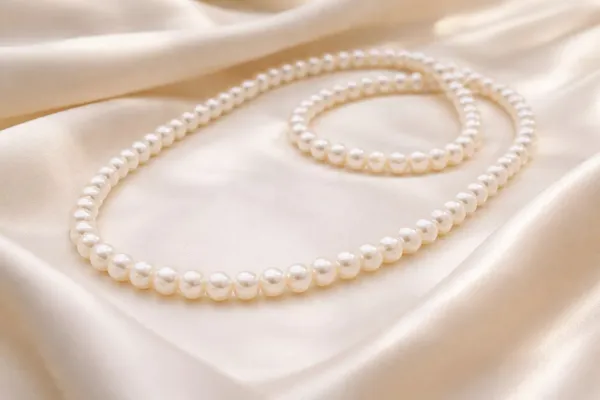
Freshwater pearls are the most varied of all cultured pearls: round, oval, drop-shaped, baroque, white, pink, peach or lavender. They are also the most affordable, which makes them ideal for a first piece of jewellery, a gift or an everyday jewel.
Where do freshwater pearls come from?
They do not come from an oyster but from a freshwater mussel of the Hyriopsis genus (Hyriopsis cumingii, often crossed with Hyriopsis schlegeli), raised in lakes and rivers. China is by far the leading producer, mainly in the Yangtze basin. It was also in China that small mother-of-pearl figurines were already being grown in freshwater mussels in the 13th century.
A different culture from saltwater pearls
For a saltwater pearl (Tahitian, Akoya), a nucleus and a piece of mantle tissue are grafted into the oyster. For a freshwater pearl, the traditional method uses only a piece of mantle tissue, with no nucleus: the pearl is therefore made of nacre almost to its core. It is solid and stands up well to wear.
A single mussel can receive many grafts at once and produce several pearls in one harvest. This is what makes these pearls plentiful, and therefore more affordable, without taking anything away from the beauty of the nacre.
Shapes, colours, sizes
Shapes
With no nucleus to guide its growth, a freshwater pearl takes very diverse shapes. Perfectly round ones are the rarest. Ovals, buttons, drops and free-form baroques lend themselves to the most original designs.
Colours
Their natural colours range from white to pale pink, through peach and lavender. These soft, luminous pastel shades go as well with silver as with gold.
Sizes
From about 2 to 13 mm: tiny pearls for delicate jewellery, up to large pearls for a necklace that gets noticed.
Choosing a freshwater pearl
The same criteria apply as for all pearls: lustre first, then surface, shape and size. A quality freshwater pearl has a bright glow and a clean surface. Our pearl encyclopedia details these criteria and compares the different types of cultured pearls.
- Freshwater: for a variety of shapes and colours, at a gentle price.
- Akoya: for a classic white with a mirror-like lustre.
- Tahitian pearl: for dark colours and large sizes.
Our freshwater pearl jewellery
- Freshwater pearl bracelets
- Freshwater pearl necklaces
- Freshwater pearl pendants
- Freshwater pearl earrings
- Freshwater pearl rings
Not sure about the style? Our article How to choose the right jewel for your style can help.
Caring for your freshwater pearls
- Put them on after perfume and cosmetics.
- Wipe them with a soft cloth after wearing.
- Store them separately to avoid scratches.
- Take them off to swim or do housework.
Frequently asked questions
Are freshwater pearls real pearls?
Yes, they are real cultured pearls, made of nacre just like saltwater pearls. Only the mollusc changes: a mussel instead of an oyster.
Why are they cheaper than saltwater pearls?
Because a mussel produces several pearls at once and their culture is more abundant. The quality of their nacre does not suffer for it.
Are their colours natural?
White, pink, peach and lavender are natural colours. Black or brightly coloured freshwater pearls, on the other hand, are dyed.