


The Akoya pearl is the classic pearl par excellence: small, very round, with an almost mirror-like lustre. It made Japanese cultured pearls famous, and it is still the reference for a strand of white pearls or a pair of pearl studs.
Where do Akoya pearls come from?
They are born in the Pinctada fucata (Pinctada fucata martensii in Japan), a small sea oyster of 7 to 8 cm. Japan is their birthplace: it was with this oyster that Kokichi Mikimoto developed the round cultured pearl in the early 20th century, and it has been farmed there for more than a hundred years.
Today, Akoya pearls are also cultured in China and South-East Asia, especially in Thailand. We visited a pearl farm in Phuket, which is one of our suppliers.
How is an Akoya pearl formed?
The principle is the same as for all saltwater cultured pearls: the pearl farmer grafts into the oyster a nucleus (a shell bead) and a small piece of mantle tissue from a donor oyster. The oyster covers this core with nacre, layer after layer.
Because the Akoya oyster is small, so is the pearl, and its culture is shorter: about one to two years. Its nacre layer is therefore thinner than that of a Tahitian pearl, which calls for a little more care.
Sizes, colours, lustre
Sizes
Akoya pearls measure 2 to 9 mm, most often 6 to 9 mm. Above 9 mm, they become rare. This modest size is what makes them so easy to wear, on any occasion.
Colours
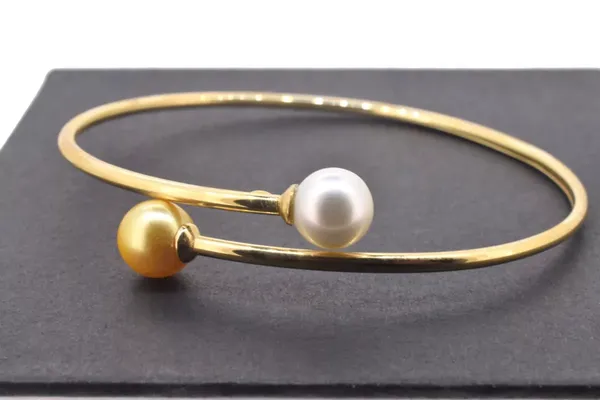
Naturally white or cream, they often show a pink, silver or champagne overtone. There are also golden Akoya pearls, especially from the warmer waters of South-East Asia, and darker ones. Like many white pearls, they are often lightly bleached to even out their colour: a common practice that does not affect the quality of the nacre.
Lustre and shape
This is their great strength. A beautiful Akoya reflects light like a mirror, and its shape is often very regular. That is what makes it the ideal pearl for strands, where all the pearls must look alike.
Akoya, Tahitian or freshwater: which one to choose?
- Akoya: for classic elegance and brilliance, in white or cream, in discreet sizes.
- Tahitian pearl: for dark colours and unique overtones, in more generous sizes.
- Freshwater pearl: for a variety of shapes and colours, at a gentler price.
Our pearl encyclopedia compares all types of cultured pearls in detail.
Our Akoya pearl jewellery
Caring for your Akoya pearls
- Put them on last, after perfume, hairspray and make-up.
- Wipe them with a soft cloth after each wear.
- Store them separately, in a box or pouch.
- Take them off to swim: chlorine and salt dull the nacre.
- For a strung necklace, have the thread checked every one to two years.
Frequently asked questions
Are Akoya pearls saltwater pearls?
Yes, they are saltwater cultured pearls grown in an oyster, unlike freshwater pearls, which grow in a mussel.
What size should I choose for Akoya earrings?
6 to 7 mm for a very discreet look, 7.5 to 8.5 mm for a more visible glow every day.
Can an Akoya pearl be golden?
Yes, some Akoya pearls are naturally golden, especially those grown in the warm waters of South-East Asia.