


Tahitian pearls come from a single place in the world: the lagoons of French Polynesia. They are also the only naturally dark cultured pearls. Deep black, silver grey, green, aubergine, bronze, peacock overtones… their colour owes nothing to dye: it comes from the oyster that grew them.
At Poemana, you will find them in almost all of our creations. Here is what you need to know to understand them, choose them and keep them for a long time.
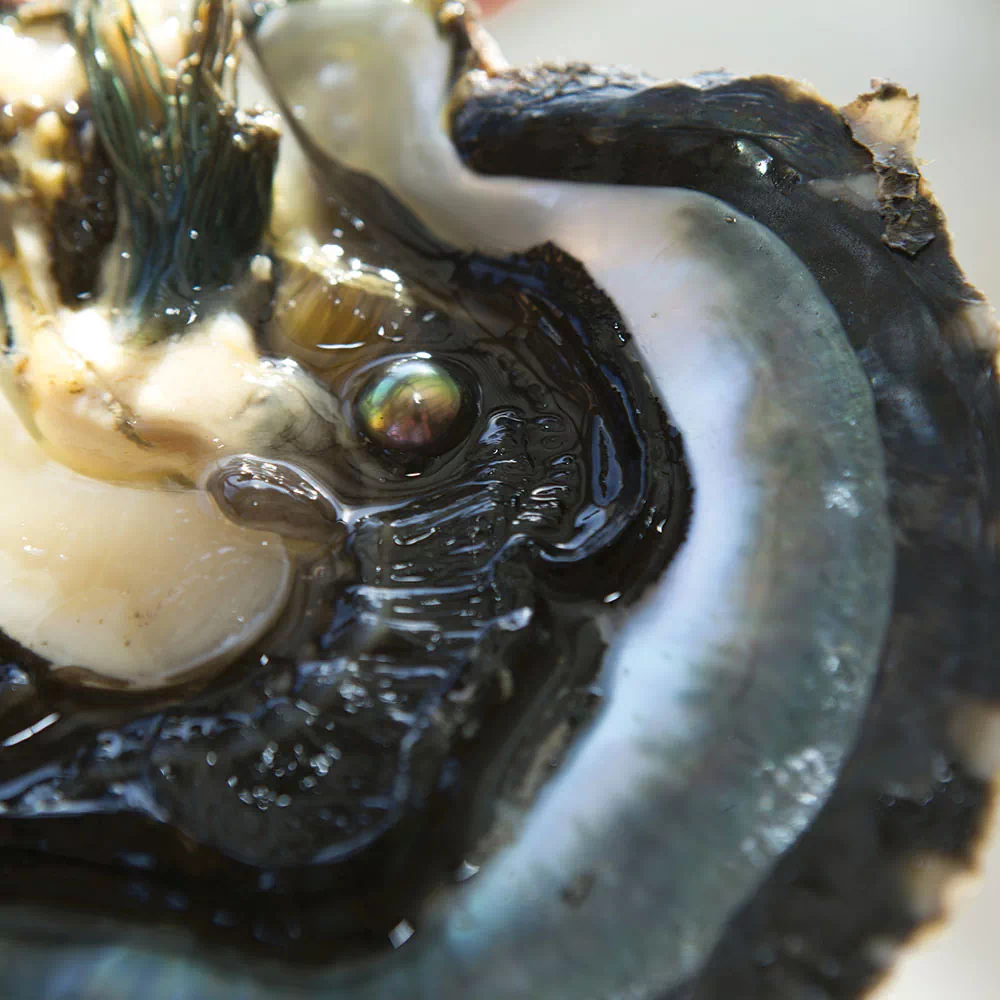
One oyster, one lagoon: where Tahitian pearls come from
The Tahitian pearl is born in the Pinctada margaritifera, the black-lip oyster of the Polynesian lagoons. Its nacre, and its nacre alone, gives these dark shades. A "black" pearl grown elsewhere, or a white pearl coloured artificially, is not a Tahitian pearl.
The technique itself comes from Japan. In the early 20th century, Kokichi Mikimoto perfected the graft that makes it possible to grow a pearl in a controlled way. The know-how then spread across the Pacific and found the ideal oyster in Polynesia.
Three to four years for one pearl
Raising the oysters (2 to 3 years)
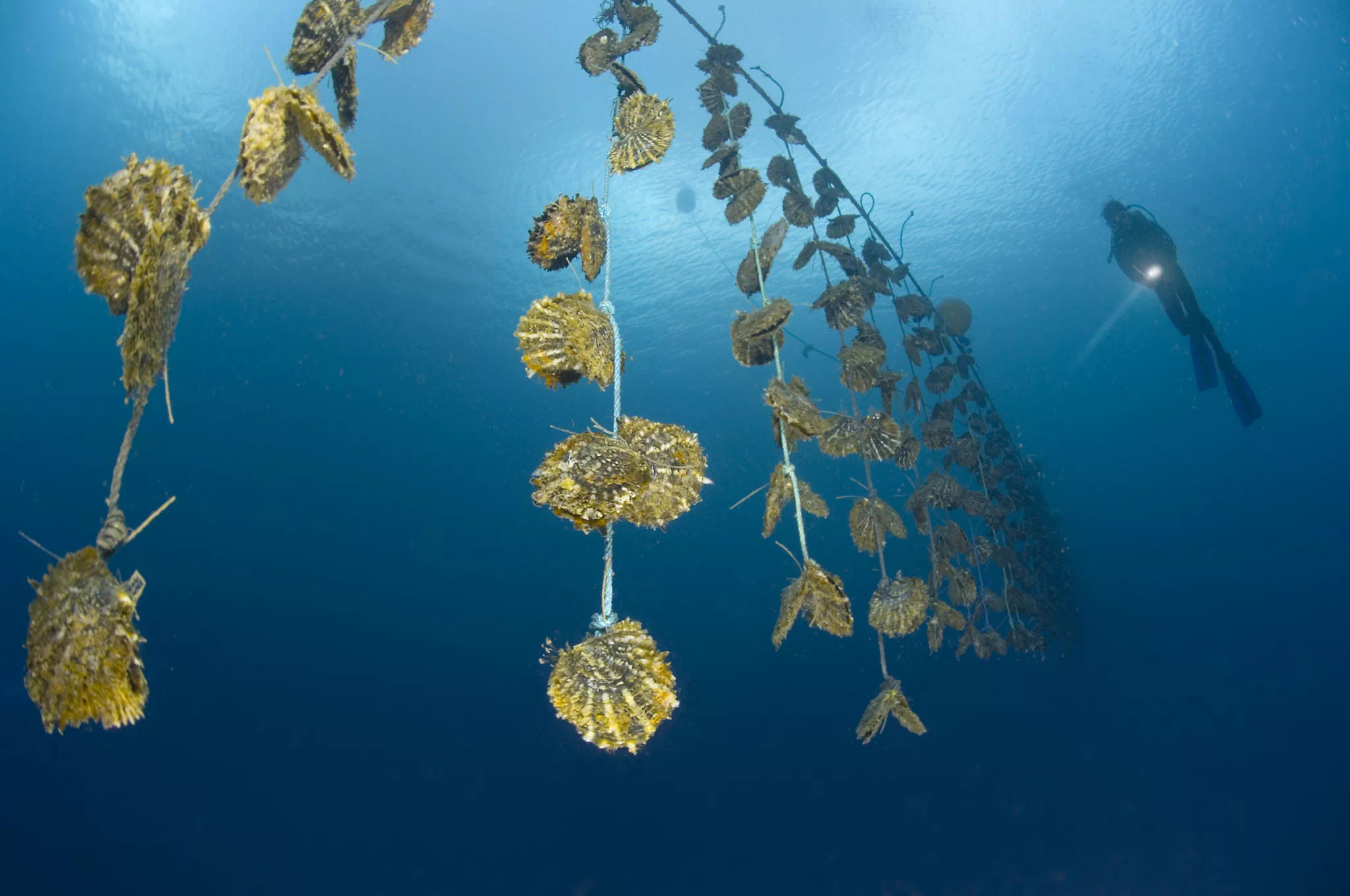
Young oysters first grow in the lagoon for about two years, until they reach 5 to 10 cm. They are then drilled and hung on lines for one more year, and regularly cleaned of algae and parasites.
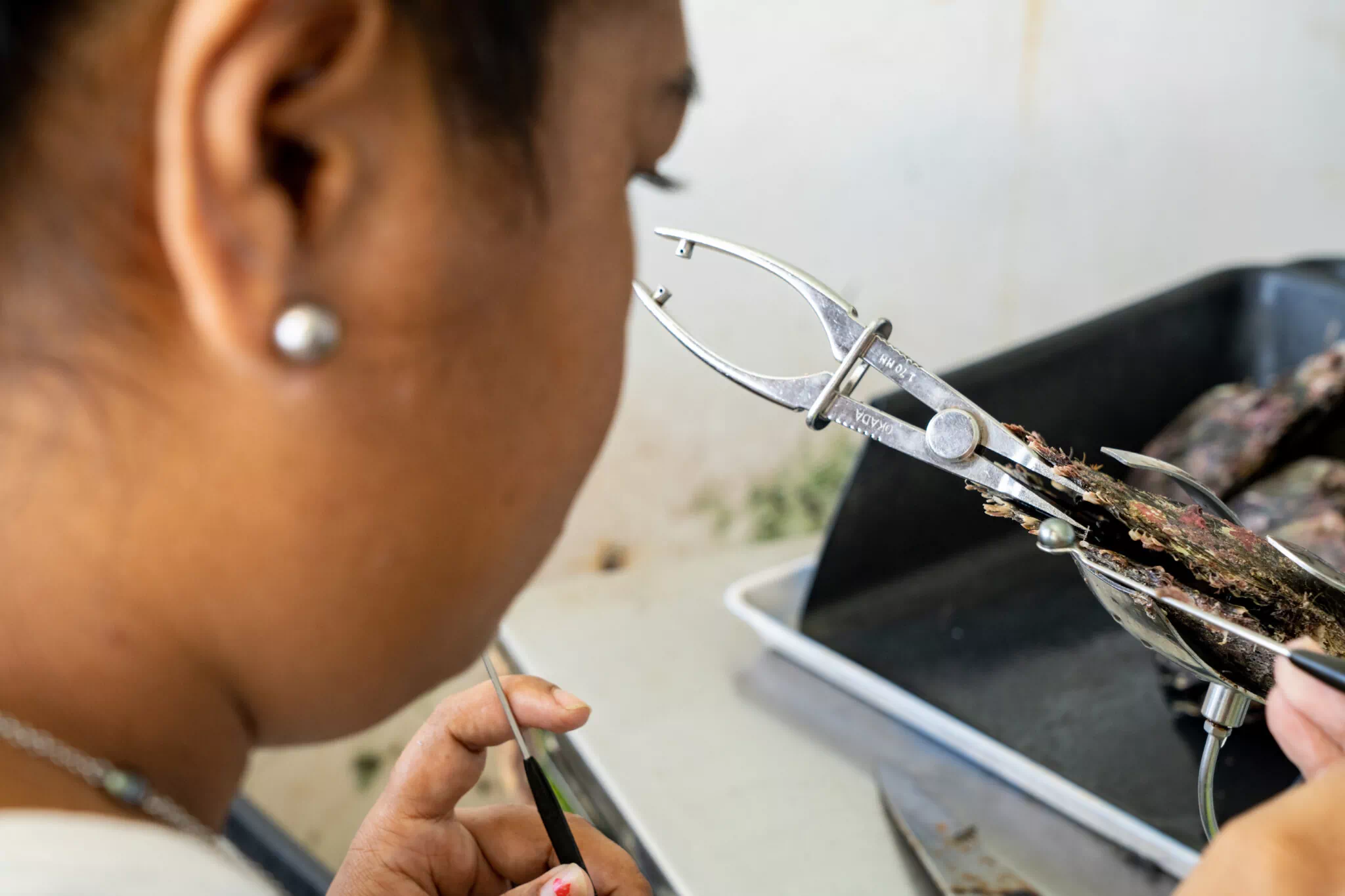
The graft
This is the decisive step. The grafter gently opens the oyster and places in its pearl pocket a nucleus (a polished shell bead) and a graft, a small piece of mantle tissue from a donor oyster. The graft forms the pearl sac that lays down nacre, layer after layer, around the nucleus. It also passes on the colour: a donor with green overtones will tend to give green pearls.
Growing the pearl (18 to 24 months)
The grafted oysters go back to the lagoon for at least 18 months, often 24. They are watched, cleaned, and the pearl slowly grows. In the end, only a small share of the grafted oysters gives a pearl worthy of a jewel.
Colours, shapes, sizes: the diversity of Tahitian pearls
Colours
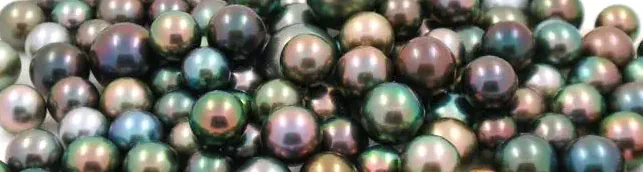
We distinguish the body colour (from light grey to black) and the overtone, the reflections playing on the surface: green, blue, aubergine, pink, copper. The "peacock" overtone, a blend of green and aubergine, is one of the most sought after.
Shapes
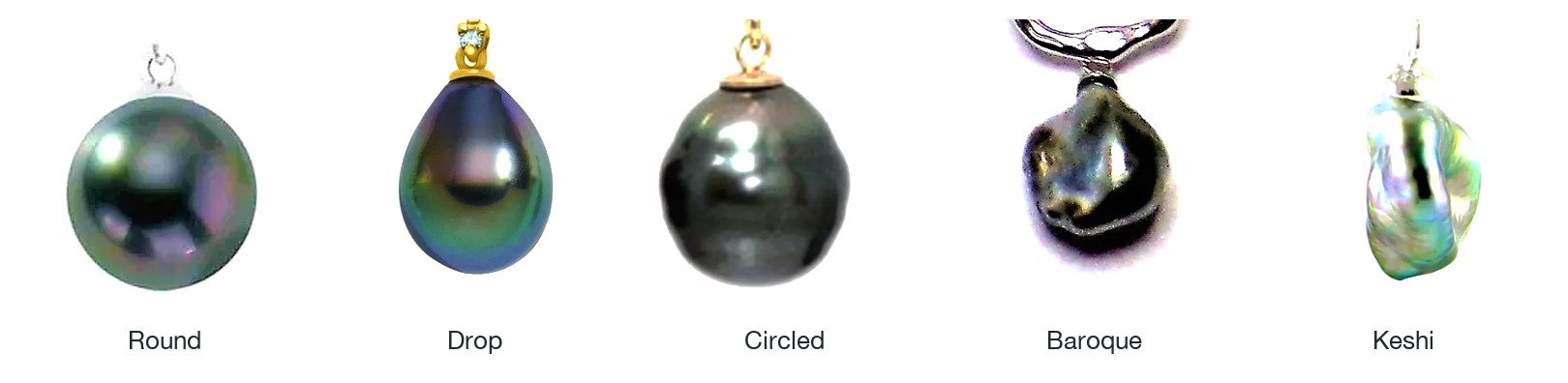
A perfectly round pearl is rare. The other shapes each have their charm: near-round, button, drop, oval, circled (with raised rings), semi-baroque, baroque. Keshi pearls, small all-nacre pearls formed without a nucleus, have free shapes and a very bright lustre. Drops make beautiful pendants and earrings, baroques make jewellery with a strong character.
Sizes
Tahitian pearls usually measure 8 to 14 mm. For a bracelet worn every day, 8 to 10 mm stays discreet, while 11 to 12 mm gives more presence. Most of our bracelets use 8 to 12 mm pearls, and up to 14 mm for a few exceptional pieces. Our article What size pearl should I choose for a bracelet? explains this choice in detail.

How to recognise a beautiful Tahitian pearl
Four criteria matter, in this order:
- Lustre: the brilliance of the pearl, how well it reflects light. A round but dull pearl is worth less than a bright baroque one.
- Surface: a few small marks are normal, they are the signature of a living material. Visible flaws are what lower the quality.
- Nacre thickness: it is what makes a pearl last. French Polynesia long required a minimum of 0.8 mm, checked by X-ray before export.
- Shape and size, depending on the jewel and on personal taste.
To learn more about quality grades and certificates, read our guide to choosing your Tahitian pearl.
Matching pearls: the jeweller's work
Since no two pearls are ever identical, each jewel requires patient sorting. For a pair of earrings, we need two pearls with the same diameter, lustre and overtones, sometimes found among hundreds. For a necklace, the choice is between near-perfect uniformity, which is very rare, and a gradient of shades that makes a harmonious strand. A bracelet allows more freedom: a full strand of Tahitian pearls, or one or two pearls combined with natural stones, a style men particularly like.
Our Tahitian pearl jewellery
Each pearl is chosen one by one. Our jewellery is assembled by hand in France, on 18-carat gold (yellow, white or rose), rhodium-plated 925 silver, or on cord. We also make bespoke pieces, with a selection of pearls chosen for you.
- Tahitian pearl bracelets
- Tahitian pearl necklaces
- Tahitian pearl pendants
- Tahitian pearl earrings
- Tahitian pearl rings
Caring for your Tahitian pearls
Their thick nacre makes them resistant, but they remain organic gems:
- Put on perfume and cream before the jewel, never after.
- Avoid chlorine, salt and household products. Take them off to swim (see our tips for wearing your pearls at the beach).
- Wipe them with a soft cloth after wearing.
- Store them separately, in their box, away from jewellery that could scratch them.
- Wear them often: contact with the skin does them good.
Frequently asked questions
What is the difference between a Tahitian pearl and a dyed black pearl?
A Tahitian pearl gets its colour from the Pinctada margaritifera oyster. A dyed black pearl is a light pearl, often freshwater, coloured artificially. Its colour is more uniform, with no real overtone.
Why do well-matched earrings cost more?
Because many pearls must be sorted to find two that are true twins in size, lustre and overtones.
Can Tahitian pearls be worn every day?
Yes, that is actually what suits them best, as long as you follow the few care tips above.
Are Tahitian pearls suitable for men?
Absolutely. On a cord or combined with natural stones, they look great next to a watch, with understated style.
To discover other cultured pearls, see our pearl encyclopedia, or our pages on Akoya pearls and freshwater pearls.