


Published on 11 July 2025
Why read this guide?
Are you dreaming of a Tahitian pearl necklace, a ring set with a black pearl, Tahitian pearl earrings or a Tahitian pearl pendant?
This guide takes you step by step through all the expert criteria for choosing a gem that is authentic, durable and fairly priced.
Because luxury begins with knowledge, this guide was designed for you, discerning readers with confident style. You will discover, step by step, the secrets of these mysterious gems: from the subtle thickness of their nacre to the play of orient that brings their surface to life, not forgetting the precise criteria—shape, lustre, surface—that will make all the difference in your next purchase of Tahitian pearl jewellery.
Our ambition? To offer you far more than a simple list of tips. We want to immerse you in the art of pearl farming, to let you feel the warm breath of the atolls and hear the delicate clink of pearls being selected one by one to compose our pieces. Through these pages, you will learn how to match your personality to the shimmering palette of peacock green, aubergine or silver grey, and how to recognise the expert hand that polishes each gold or silver setting.
By the end of this chapter, you will know why a high-end Tahitian pearl offers that extra soul that imitations can never provide. You will be ready to choose with complete confidence the piece that will become your signature, and to savour the lasting pleasure of jewellery made with authentic Tahitian pearls.
Overview – What is a Tahitian pearl?
In short:
- An exceptional birth: a jewel formed by the Pinctada margaritifera oyster in the lagoons of French Polynesia.
- A natural palette – from peacock green to aubergine, without treatment or dye; only a few rare “chocolate pearls” undergo colouring.
- Generous in size: common diameter of 8 to 14 mm, reaching up to 18 mm for collector's pieces.
- Official guarantees: export subject to a minimum nacre thickness of 0.8 mm, a guarantee of deep orient and longevity.
________________________________________
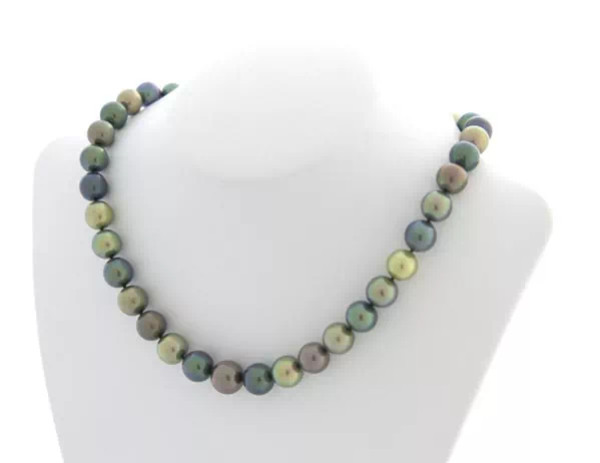
When we think of the Tahitian cultured pearl, we immediately picture that dark, velvety sheen that seems to capture the light only to release it in an iridescent halo. This magic is born at the heart of the Pinctada margaritifera oyster, known as the “black-lipped oyster”; its dark mantle naturally gives the pearl its unique range of colours – peacock green, aubergine, silver grey, sometimes crossed by a pink or pistachio overtone. Unlike Akoya or freshwater pearls, which are often bleached or dyed, the Tahitian black pearl shows its original colour here; only certain very specific chocolate tones may result from post-harvest treatment, an exception that proves the rule of a naturally rich palette.

This Polynesian treasure is also impressive in stature: with a “classic” diameter of between 8 and 14 mm, the Tahitian pearl exceeds most sea pearls, and specimens of 17 or 18 mm join the very exclusive circle of collector's pieces coveted by connoisseurs. This generosity is not just a matter of millimetres; it comes with thick nacre – a minimum of 0.8 mm required by local regulations – whose successive layers act like so many micro-mirrors, creating the silky orient recognisable at first glance.
At the Poemana workshop, each piece of Tahitian pearl jewellery bears witness to this natural alchemy: we select the gems in their natural state, without colouring, then enhance their living shades with gold or silver. This is why a necklace of authentic black pearls does more than adorn the neck; it tells of the slow breathing of a lagoon, the patience of a culture lasting 18 to 36 months, and the rigour of a sorting process in which fewer than one per cent of pearls earn the “Top Gem” distinction.
Having reached this first stage of the guide, you can already grasp the intrinsic value of a high-end Tahitian pearl: a work of nature preserved by a demanding industry, for a lasting luxury that you wear and pass on.
From lagoon to jewel: the life cycle of a pearl
In short:
- Expert grafting: insertion of a nucleus and a graft of nacre-producing tissue into the Pinctada margaritifera oyster.
- Long-term culture: 18 to 36 months suspended in the lagoons to obtain nacre ≥ 0.8 mm.
- Regular care: cleaning of the shells, monitoring of salinity and temperature.
- Harvest & sorting: fewer than 5% of pearls reach the higher grades, and only 1% earn “Top Gem”.
- Poemana expertise: cleaning, micro-drilling, mounting in gold or silver and final quality control in France.
________________________________________
It all begins with a gesture of great precision: the graft. Into the oyster's nacre-producing mantle, the master grafter slips a small spherical nucleus – usually of Mississippi mother-of-pearl – along with a fragment of tissue from a donor oyster. This delicate operation, comparable to planting a seed, triggers the secretion of concentric layers of nacre; this is how each grafted Tahitian pearl is born, the future star of your jewellery.

Next comes the long patience of the lagoons. Suspended from lines, the oysters sway gently with the currents. It takes them eighteen to thirty-six months to wrap the nucleus in sufficiently thick nacre: Polynesian regulations require a minimum of 0.8 mm before any export, guaranteeing brilliance and durability. The farmers raise the lines at regular intervals to remove algae and parasites and to monitor salinity, temperature and water quality – a true marine spa in the service of lustre.

When the pearl has matured, it is time for the harvest: the oyster is opened with a sure hand, the gem is carefully extracted, and the shell is then closed to allow, if the animal is healthy, a second graft. This is where the sorting begins. Shape, surface, lustre, colour: the experts handle each pearl under cold light. Only 1 to 5% join the prestige category, while a tiny elite – around 1% of the harvest – displays a perfect orient and earns the “Top Gem” distinction.

Once through this selection, the pearls set off for Paris, where our Poemana workshop orchestrates the final transformation. Light polishing to bring out the play of reflections, micro-drilling, then hand-setting in 750‰ gold or 925‰ silver. Each piece of Tahitian pearl jewellery is then inspected, numbered and accompanied by its certificate – a witness to the journey that brought it from the translucent waters of Polynesia to your jewellery box.
So behind the brilliance of a Tahitian black pearl lie years of care and expertise, a virtuous chain in which nature, human skill and strict regulation come together to offer a lasting luxury – one that you will wear with pride, season after season.
The 7 essential quality criteria
In short:
- Ideal or creative shape: perfectly round for the solitaire ring, a sensual drop for the pendant, sculptural baroque for the work of art.
- Strategic size: from 8 mm to 14 mm for most jewellery, up to 18 mm for exceptional pearls.
- Impeccable surface: 95% to 99% clean to aim for AAA or Top Gem grade.
- Mirror lustre: the deep satin sheen typical of black pearls, essential to the “fine jewellery” effect.
- Nacre thickness: legal threshold of 0.8 mm, a guarantee of durability and intense orient.
- Colour & orient: a natural palette of peacock green, aubergine and silver grey, enhanced by pistachio or pink overtones.
- Perfect matching: harmony of size, colour and lustre for necklaces and earrings.
Shape — the aesthetic signature
A round Tahitian pearl (variation ≤ 2%) draws the eye in search of perfection; set in white gold, it becomes the focal point of a black pearl ring with a couture feel. Drop or pear shapes, for their part, naturally follow the fall of a pendant and flatter the line of the neck, while authentic baroque pearls – free contours, sculptural silhouettes – bring an artistic spirit to a bracelet or a long necklace. Whatever your preference, remember that an original shape must remain balanced: high-end jewellery converses with the body and never contradicts it.

Size — the right volume
On a 10-11 mm Tahitian pearl necklace, each gem has a subtle presence without weighing down the neck; perfect with a city suit or a cocktail dress. Once past 13 mm, the look becomes spectacular: the pearl breathes, projects more light and gets noticed even in the soft glow of a dinner. Diameters of 16 mm and above belong to collector's pieces; their rarity makes them investments as much as jewels.

Surface — the inner mirror
Under neutral lighting, slowly rotate the pearl: the AAA category tolerates tiny scattered pits, invisible at conversation distance, while a Top Gem surface looks like a liquid sphere. On a baroque Tahitian pearl, small ridges can enhance its character; the key is that no flaw should concentrate the light in a distracting way.

Lustre — the soul of the pearl
Warm lagoons rich in plankton nourish a dense nacre; light penetrates it and is reflected through multiple layers, creating that mysterious orient that unfailingly distinguishes a high-end Tahitian pearl from a dyed imitation. Aim for at least a “Good” lustre; for a ring or earrings, the mirror effect of an “Excellent” lustre enhances every movement of the head.

Nacre thickness — the promise of longevity
French Polynesia strictly controls exports: 0.8 mm of nacre, measured by X-ray, is the minimum for leaving the territory.
At Poemana, the average is more like 2 mm to 3 mm; this is what creates depth of colour and resistance to micro-scratches. Choosing thick nacre means investing in a piece of jewellery that will last for decades.
Colour, orient and overtone — the living palette
Peacock green shimmers with a crown of indigo, aubergine glows with a coppery halo, silver grey often takes on a discreet pistachio overtone. Each piece of jewellery with authentic Tahitian pearls thus becomes unique, like a captured fragment of lagoon. For a complete set, choose similar shades; for a statement piece – a solitaire pendant or cocktail ring – dare to contrast with rose gold or a baguette-cut diamond.

Matching — orchestrated harmony
Composing a strand takes a musical ear: the pearls are arranged in increasing size towards the front, and their reflections aligned like notes on a stave.
On black pearl earrings, strict symmetry of diameter and colour is essential; identical lustre ensures a consistent sparkle on either side of the face. Our workshop sometimes sorts more than a hundred pearls to keep just two: selection is the true definition of luxury.
________________________________________
By mastering these seven parameters, you can decode the real value of a piece of jewellery and adopt the expert eye of a gemmologist. The next time a Tahitian pearl necklace catches your eye, you will know how to read its light, judge its surface and sense the density of its nacre — and choose, with complete confidence, the piece destined to become your signature.
Classification systems & certificates
In short:
- Two major standards: the Polynesian A → D scale (with Top Gem at the very top) and the international GIA AAA → A scale.
- An equivalence worth knowing: a Polynesian “A” pearl is worth a solid “AAA” in the GIA system.
- Reading a certificate: shape, lustre, surface, diameter and nacre thickness are always shown – the AAA Tahitian pearl grade should appear there in black and white.
- Mandatory traceability: batch number issued by the Service de la Perliculture de Polynésie and X-ray inspection before export.
Two alphabets for the same excellence
Locally, pearl farmers apply the A-B-C-D system: the letter A indicates less than 5% imperfections and very high lustre; D brings up the rear with heavy flaws. At the top, the Top Gem distinction crowns pearls with an almost perfect mirror finish. For export, this local hierarchy is paired with the international GIA classification, expressed as “AAA, AA+, AA…”, a language often more familiar to European jewellery houses. Knowing how these two alphabets relate avoids many misunderstandings: the Polynesian “A”, envied for its purity, outranks the worldwide “A”, which is relegated to entry level.
Decoding the certificate of authenticity
Receiving your jewel with a Tahitian pearl certificate of authenticity is not a superfluous luxury – it is the gem's identity card. Read it as a sommelier reads the label of a great wine:
- Shape: “Round” or “Drop”, a guarantee of the visual signature.
- Precise diameter: expressed to 1/10 mm; 10.2 mm is not 9.9 mm.
- Lustre: Excellent, Good, Pale.
- Surface: AAA, AA+, etc.
- Nacre thickness: ≥ 0.8 mm (mandatory); the ideal is between 2 and 3 mm.
This document must also state the Polynesian batch number or make it possible to find it through the workshop's internal traceability; it guarantees that the pearl has passed the official X-ray inspection and ensures traceability from the lagoon to your jewellery box.
Why grade shapes price
Between an AA+ and an AAA pearl, the differences are often invisible to the untrained eye; yet they send the value soaring. On a solitaire ring, the slightest pit becomes central; only an AAA or Top Gem grade can stand up to scrutiny at a cocktail party under overhead lighting. For a long necklace, you can accept a few well-placed AA+ pearls, provided that the overall matching preserves the consistency of lustre and colour. Here again, Poemana's expert eye decides – our house policy excludes any pearl below AA grade; the high-end promise remains intact.
Armed with this knowledge, you can now read a certificate the way you leaf through a passport: written proof that a pearl has earned its place among your treasures, and that luxury, at Poemana, always goes hand in hand with transparency.
Choosing your pearl according to your jewellery project
In short:
- Signature ring: round 9-11 mm, mirror lustre, 750‰ gold setting.
- Statement pendant: drop 10-13 mm, peacock or aubergine colour for a magnetic sparkle.
- Earrings: matched pair 8-10 mm, AAA surface, discreet “collet” setting.
- Classic strand necklace: harmonious progression 9 → 11 mm, 35 to 45 matched pearls.
- Baroque bracelet: 7-9 free-form pearls, sculptural silhouettes, an arty chic look.
To explore this choice further, see also our selection of Tahitian pearl bracelets, with models for women and men on gold, silver, leather or cord.
The solitaire ring – the everyday icon
For a Tahitian black pearl ring to become your talisman, choose a perfectly round gem between 9 and 11 mm: it catches the light without getting in the way, and its mirror lustre enhances the slightest French or glamorous red manicure. We favour 750‰ white or rose gold: these precious alloys bring out the depth of peacock green while remaining neutral enough for everyday wear. Treat yourself to an AAA or Top Gem grade; at conversation distance, the slightest pit would be visible.
The pendant – a drop of light
A Tahitian pearl drop pendant of 10 to 13 mm creates a majestic effect, especially on a trace chain or a minimalist gold cable. Let nature put on the show: an aubergine orient wraps the pearl in a coppery halo, while a peacock green shade catches the eye at the slightest movement. If you like diamonds, surround it with fine grain pavé; the lively brilliance then contrasts with the satin depth of the pearl.
Earrings – the symmetry that flatters the face
Authentic black pearl earrings are best kept elegant and light: go for a matched pair of 8-10 mm, grade AA+ or AAA, with a flawless surface. The “collet” setting (360° view of the pearl) plays the understated card; if you prefer sparkle, a surround of brilliant-cut diamonds creates a button of light that brightens the complexion. Insist on a perfect match of lustre and shade – your reflection in the mirror should reveal two twin gleams.
The necklace – the art of the harmonious strand
A high-end Tahitian pearl necklace combines patience with a flawless eye: 35 to 45 pearls matched in colour, lustre and orient are often strung with a subtle progression from 9 mm near the clasp to 11 mm at the centre. This visual build-up slims the neck and anchors the silhouette. For a couture look, opt for a ball clasp set with diamond pavé; for a Riviera style, choose the classic T-bar in rhodium-plated silver.
The bracelet – baroque chic
The baroque Tahitian pearl bracelet embodies creativity: seven to nine gems of free-form volume answer one another like miniature sculptures. The natural ridges catch the light, creating an irresistible visual texture on the skin. Mount them on a steel-sheathed cable for a modern twist, or on a knotted silk thread for tradition. Here, AA grade is enough; the personality of the shapes matters more than absolute perfection.
________________________________________
Final tip: always think of the use before the gem. A spectacular pendant does not have the same constraints as an everyday ring; a ceremonial necklace can tolerate one or two AA+ pearls within an AAA strand, whereas a pair of earrings must remain beyond reproach. By keeping this logic of function + style, you will naturally find the authentic Tahitian pearl that will tell your story with accuracy and light.
Care & storage – preserving the sparkle of your pearls
In short:
- Gentle cleaning: microfibre cloth + warm water, never harsh chemicals – the basis of good Tahitian pearl care.
- The final beauty step: perfume, hairspray and make-up first; pearl jewellery afterwards, to avoid deposits.
- Careful storage: silk-lined box, moderate humidity, limited contact with hard metals.
- Regular restringing: every three to four years for a Tahitian pearl necklace, service offered once at Poemana.
Cleaning your Tahitian pearl jewellery
Nacre is an organo-mineral material: it loves gentleness and hates acidity. After each wear, wipe your pearls with a microfibre cloth to remove traces of cream and urban pollution. If more thorough cleaning is needed, immerse them for twenty seconds in warm, very lightly soapy water (neutral pH Marseille soap), rinse, then dry flat on a cloth. Avoid alcohol, vinegar and detergents: they would permanently dull the satin orient of a genuine Tahitian black pearl.
The right habit: jewellery last
Perfumes, hairsprays, dry oils… all friends of the skin but enemies of nacre. Adopt the “Tahitian pearl jewellery last” rule: a simple habit that prevents a trail of alcohol or micro-droplets of hairspray from settling on the surface. Your strand will keep its mirror lustre for longer.
Storage: a jewellery box, not a safe
Unlike diamonds, pearls like a touch of ambient humidity; too much dryness can weaken the nacre. Keep them in a box lined with silk or velvet, away from your steel rings or bracelets to avoid micro-scratches. Do not hang a long necklace: the thread could stretch.
Restringing, a habit for longevity
Silk thread, even when doubled, loosens over time. Every three or four years – sooner if you wear your high-end Tahitian pearl necklace very often – have it restrung. Poemana offers the first restringing and, at each service, checks lustre, surface and settings. A discreet luxury and a guarantee of durability.
________________________________________
By following these simple steps, your jewellery with authentic Tahitian pearls will pass through the years without losing its velvety light – ready to enhance today's outfits and the heirs of tomorrow.
FAQ – Your most frequently asked questions
Can I wear my pearls in the shower or at the beach?
Pearls are born in salt water, but their sparkle dulls with repeated contact with surfactants and chlorine. Soap, shampoo and sun cream leave a residual film that veils the orient, while sea salt gradually attacks the silk holding your strand together. Before you dive in or step into the shower, leave your pearls in their box: this is the secret to keeping the satin shine of your Tahitian pearl necklace for a long time
How can you recognise an authentic Tahitian pearl, in a shop or online?
Three clues never lie:
- The essential certificate.
- The “tooth” test: gently rub the pearl against the edge of your incisor – a slightly gritty feel reveals the overlapping layers of nacre; glass or resin slides smoothly without catching.
- The living orient: turn the gem in natural light and a range of peacock green and aubergine shades appears and disappears; a fake pearl keeps a uniform, slightly “plastic” colour.
Online, steer clear of offers advertising a 14 mm “AAA” at a ridiculously low price: a certified pearl of that diameter always means a serious investment.
Look for photos taken from different angles: might those round pearls turn out to be semi-round after all?
Tahitian pearls are often described as black pearls, but the reverse is not true. The term black pearl alone often conceals a dyed freshwater pearl.
Which necklace length should you choose for a timeless style?
The princess length, around 45 cm, rests at the base of the collarbone; it flatters a V-neck as well as a boat neck. This length remains the most versatile for a high-end Tahitian pearl necklace: worn with a white shirt at the office or a cocktail dress, it provides instant elegance without weighing down the silhouette.
Are my pearls likely to lose their shine?
Nacre is delicate: acids, perfumes and cosmetics can attack it. Wiping with a microfibre cloth after each wear and storing in a silky box are enough to preserve the orient. If your jewel seems to be losing its glow, gentle cleaning with warm soapy water will revive its sparkle; however, avoid solvents and ultrasonic cleaning, which are reserved for harder stones.
What budget should I plan for a necklace of certified Tahitian pearls?
Allow from €1,200 for a strand of 35 AA+ baroque pearls of 8-9 mm, mounted on rhodium-plated silver. A round AAA 9-11 mm version with a gold clasp and knotted silk ranges from €3,500 to €6,000 depending on the consistency of colour and the lustre. From 12 mm upwards, each additional millimetre drives up the value, because worldwide supply becomes scarce.
Can I transform or restring my necklace?
Absolutely! Restringing every three or four years secures the strand and allows the clasp to be updated. At Poemana, the first restringing is free of charge; our jewellers can also detach two pearls to create matching earrings, or add a diamond clasp to transform your black pearl necklace into a piece of fine jewellery.
________________________________________
You now know how to protect your jewellery with authentic Tahitian pearls, spot counterfeits and choose the length that best suits your look. All that remains is the most enjoyable part: letting your pearl tell its story on your wrist, around your neck… and, one day, to the next generation.
Glossary – Talk pearls like an insider
- Pearl farming: the rearing of pearl oysters, including grafting, culture, cleaning and harvesting.
- Nucleus: a bead of mother-of-pearl implanted as a growth support.
- Graft: a fragment of nacre-producing mantle inserted with the nucleus to induce the formation of nacre.
- Nacre: microcrystalline layers of aragonite bound by conchiolin, forming the inner shell and the surface of the pearl.
- Keshi: a small pearl without a nucleus, 100% nacre, resulting from a failed graft; free forms, brilliant lustre.
- Mabé: a hemispherical half-pearl cultured against the inner wall of the oyster and then cut out.
- Baroque: a pearl with irregular, asymmetrical contours; each piece is unique.
- Button: a slightly flattened (domed) pearl, perfect for earrings worn close to the lobe.
- Circled: a pearl with circular grooves perpendicular to its axis.
- Drop: a symmetrical pear-shaped pearl, ideal for a pendant.
- Orient: the internal iridescence that makes colours vibrate, the visual signature of quality.
- Lustre: surface shine; classified as Excellent, Good, Pale, Poor.
- Chocolate pearl: a chocolate-brown Tahitian pearl, a very rare natural colour or one obtained by gentle heat treatment.
- Peacock green: an emblematic and highly sought-after colouring combining greens, blues and pinks.
- T-bar ring: a “T”-shaped clasp slipped through a ring, stylish and easy to handle for bracelets and necklaces.
- Choker / Princess / Matinee / Opera / Rope: necklace lengths (38 cm, 45 cm, 55 cm, 75 cm, 90 cm+).
This glossary gives you a few keys for talking like an expert and deciphering every detail of your future high-end Tahitian pearl jewellery.